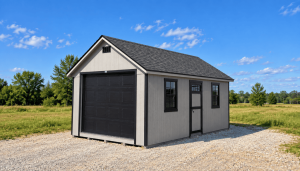
We’ve learned from experience that it’s a good idea to insulate most sheds. Whether you’re buying a pre-built garden shed that you’re going to spend hours in over the spring and summer or you want a high-quality storage shed to keep your equipment dry, insulation can help.
Here’s what you should and shouldn’t do when insulating a shed:
Understanding the Importance of Insulation
Not all of our pre-built sheds need to be insulated; some of our sheds, like our workshop-style shed, come with insulated walls. There are, however, a number of reasons why you might want to insulate your shed:
- You’re storing heat, cold, or moisture-sensitive objects.
- You’re planning to use your shed as a chicken coop (or another home for animals).
- You plan on spending a lot of time in your shed.
Insulation helps to keep your shed dry; it also helps to control the temperature of your shed. Here on the Canadian Prairies, we see some of the biggest fluctuations in temperature in the entire world; proper insulation can help keep your shed comfortable whether it’s -40°C or +30°C.
You’ll need heating and cooling to keep your shed as comfortable as possible, of course—it’s a must if you plan on spending a lot of time in there—but insulation will help make that heating and cooling much more efficient.
Preparation Before Insulating
- Do: Assess the condition of your shed. Check to see if there are any cracks or damage in your shed’s roof or walls. Be sure to repair any damage before you begin insulating your shed.
- Do: Measure your shed’s interior. You’ll need to know exactly how much insulation you’re going to need. Remember to measure the roof as well as the walls.
- Don’t: Just measure once. By measuring at least twice, you’ll have a better idea of how much insulation you’ll actually need to buy.
- Don’t: Buy the exact amount of insulation you think you’ll need; insulation works best when there are no gaps. To ensure that you have enough insulation to cover oddly shaped areas or cutting errors, we recommend purchasing about 10% more insulation than you think you’ll need.
Types of Insulation for Sheds
- Do: Research various types of insulation. There’s no one-size-fits-all insulation solution; it all depends on the construction of your shed and what you’re using it for. Spray foam insulation is an excellent option on the Prairies thanks to its high R-values, but it’s more expensive than fibreglass or foam board insulation.
- Don’t: Just go for the least expensive option. Any insulation is better than no insulation, but if you under-insulate to save money, your shed might be uncomfortable; if it is, you’ll end up spending the money you saved—and more—on heating and cooling.
Insulation Installation Process
- Do: Thoroughly clean and prepare the shed before insulating. Remove everything from the shed, clean the walls, floor, and roof, and ensure that there’s a clean substrate to install the insulation on.
- Don’t: Forget to install a vapour barrier. These barriers help prevent water from making its way into your insulation, which can drastically reduce its R-value; they also prevent water from leaking into your shed.
Common Mistakes To Avoid
- Don’t: Obstruct your shed’s ventilation. Ventilation is an important part of your shed’s construction; without it, moisture buildup can lead to water damage and mould growth. Our pre-built sheds come with vents pre-installed; don’t cover these vents with insulation.
- Don’t: Neglect your roof and floors. Without roof insulation, your shed will get cold (or too hot); without floor insulation, your feet will get cold.
Additional Tips for Effective Insulation
Do: Check and maintain your insulation regularly. Insulating materials can become damaged by pests and water, especially if they aren’t properly installed. It’s easy to think that installation is the end of your insulation project, but like anything else, proper maintenance is essential.