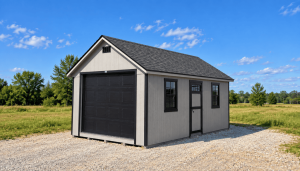
Choosing a chicken coop? Start with the usable indoor floor area per bird, then plan a separate outdoor run. The figures below assume the chickens have access to a run.
Chicken Coop Size: Quick Answer
| Chicken size | Indoor coop floor space per chicken | Outdoor run space per chicken |
|---|---|---|
| Small breeds (bantams) | 2–3 sq ft | 5–6 sq ft |
| Medium breeds | 3–4 sq ft | 10–12 sq ft |
| Large breeds | 4–5 sq ft | 12–14 sq ft |
Calculate your coop size: multiply your flock size by the indoor space per chicken. For example, 10 medium chickens need 30–40 sq ft of usable coop floor space, plus a 100–120 sq ft run. A 6 × 8 ft coop has 48 sq ft of floor area, before accounting for anything that reduces usable space. In Manitoba and other cold climates, aim toward the upper end because chickens may spend more time indoors.
See the full indoor sizing table and outdoor run table for flock sizes from 4 to 30. To explore a ready-made option, visit Horizon’s chicken coop service page.

Key Features for Chicken Coops
Four key features should be considered before purchasing any chicken coop: The roost, the nesting boxes, the run, and the ventilation.
Roost
Chickens roost in the air; doing so helps them avoid predators while protecting them from bacteria and disease. Your chicken coop should have roosts installed high above the ground and above any nesting boxes. There must be enough space for all the chickens, and the roosts must be sturdy enough to support their weight.
Nesting Boxes
Nesting boxes serve a dual purpose—they offer your chickens a comfortable place to lay their eggs and give you easy access to the eggs once they’ve been laid. They should be kept as dark as possible and installed well below the roosts. As a rule of thumb, you’ll need one nesting box for every 4-5 chickens.

Run
The chicken run is an area outside of the coop where your chickens can run around—the area is typically enclosed by a fence. As a rule of thumb, plan 5–6 square feet of run space per small chicken, 10–12 for a medium chicken, or 12–14 for a large chicken. You’ll also need excellent fencing; this fencing should be buried at least 6 inches below the ground to impede burrowing predators. Strong mesh fences are best because they impede both large and small predators.
Ventilation
Ventilation for chickens is complex; they have delicate respiratory systems and can lose insulation if the wind ruffles their feathers. As such, it’s best to install ventilation near the roof, while eliminating drafts below the roof. There’s an informative (and hilarious) guide to chicken coop ventilation that we highly recommend you check out for a detailed breakdown.
What Type of Chicken Will You Raise?
The size, demeanour, and egg-laying behaviours of chickens can vary significantly depending on the breed you choose. Here in Manitoba (and through most of the Prairies), you’ll want to choose a cold hardy breed; down in the southern United States, on the other hand, heat hardiness is key.
To get a better idea of the breeds of chicken available, we recommend the Pick-A-Chick guide by Roberts Farm. You’ll get details on the egg-laying rate, size, hardiness, behaviour, and more for several different chicken breeds.
Does the Size of the Chicken Breed Affect Coop Sizing?
Yes! Larger chickens typically need more space, and smaller chickens usually need less space. There are other factors to consider (a more active brood of small chicken may, for example, need more run space than a less active brood of standard size chickens).
With an undersized chicken coop, your chickens may become uncomfortable—it can lead to pecking and aggressive behaviour among chickens. Too much space in your chicken coop, and you’re spending money for no reason.

Chicken Coop Size Calculator Table – Inside Space
The size of your chicken coop will depend on the size of the backyard chickens you’re raising, as well as the size of your backyard flock. Here’s the rule of thumb for sizing:
Small breeds: 2-3 square feet per chicken
Medium breeds: 3-4 square feet per chicken
Large breeds: 4-5 square feet per chicken
Note that the sizing we’re using assumes you have a chicken run. You’ll also need sufficient vertical space; chickens need floor and roosting space. We should also note that here in Manitoba, you should almost always opt for larger-size coops because your chickens won’t be comfortable outside when the cold weather hits.
Coop size requirements (in square feet)
| Flock Size | Small | Medium | Large |
| 4 | 8-12 | 12-16 | 16-20 |
| 6 | 12-18 | 18-24 | 24-30 |
| 8 | 16-24 | 24-32 | 32-40 |
| 10 | 20-30 | 30-40 | 40-50 |
| 12 | 24-36 | 36-48 | 48-60 |
| 14 | 28-42 | 42-56 | 56-70 |
| 16 | 32-48 | 48-64 | 64-80 |
| 18 | 36-54 | 54-72 | 72-90 |
| 20 | 40-60 | 60-80 | 80-100 |
| 22 | 44-66 | 66-88 | 88-110 |
| 24 | 48-72 | 72-96 | 96-120 |
| 26 | 52-78 | 78-104 | 104-130 |
| 28 | 56-84 | 84-112 | 112-140 |
| 30 | 60-90 | 90-120 | 120-150 |
How Much Outdoor Run Space Do Chickens Need?
Your chickens need a fenced outdoor run in addition to their indoor coop. Choose the range for your breed size, then multiply it by the number of birds in your flock.
5–6 sq ft
of run per chicken
10–12 sq ft
of run per chicken
12–14 sq ft
of run per chicken
Example: For 10 medium chickens, plan a 100–120 sq ft run. That is roughly a 10 × 10 ft to 10 × 12 ft fenced area. Use the upper end when your breed is especially active or you expect to expand the flock.
Outdoor Run Size by Flock
Find your flock size in the first column. All areas in the table are square feet of outdoor run space; the indoor coop needs its own floor area.
| Chickens | Small breeds | Medium breeds | Large breeds |
|---|---|---|---|
| 4 | 20–24 | 40–48 | 48–56 |
| 6 | 30–36 | 60–72 | 72–84 |
| 8 | 40–48 | 80–96 | 96–112 |
| 10 | 50–60 | 100–120 | 120–140 |
| 12 | 60–72 | 120–144 | 144–168 |
| 14 | 70–84 | 140–168 | 168–196 |
| 16 | 80–96 | 160–192 | 192–224 |
| 18 | 90–108 | 180–216 | 216–252 |
| 20 | 100–120 | 200–240 | 240–280 |
| 22 | 110–132 | 220–264 | 264–308 |
| 24 | 120–144 | 240–288 | 288–336 |
| 26 | 130–156 | 260–312 | 312–364 |
| 28 | 140–168 | 280–336 | 336–392 |
| 30 | 150–180 | 300–360 | 360–420 |
Yearly Egg Production Calculator Table
On average, a small chicken (or bantam chicken) will lay about 100 eggs per year. A medium-sized chicken may lay about 200 eggs per year, while a large chicken will typically lay about 150 eggs per year. These numbers vary widely depending on chicken breeds, what the chickens are being fed, weather, temperament, and more.
With that in mind, below is an average of how many eggs your chickens will lay, depending on the size and number of chickens.
The estimated egg production for flocks of small, medium, and large chicken breeds, showing both the total number of eggs and the equivalent in dozens of eggs per year:
Egg Production Estimates (Per Year)
| Flock Size | Bantam Chickens (Total Eggs) | Bantam Chickens (Dozens of Eggs) | Medium Chickens (Total Eggs) | Medium Chickens (Dozens of Eggs) | Large Chickens (Total Eggs) | Large Chickens (Dozens of Eggs) |
| 4 | 400 | 33 | 800 | 67 | 600 | 50 |
| 6 | 600 | 50 | 1200 | 100 | 900 | 75 |
| 8 | 800 | 67 | 1600 | 133 | 1200 | 100 |
| 10 | 1000 | 83 | 2000 | 167 | 1500 | 125 |
| 12 | 1200 | 100 | 2400 | 200 | 1800 | 150 |
| 14 | 1400 | 117 | 2800 | 233 | 2100 | 175.00 |
| 16 | 1600 | 133 | 3200 | 267 | 2400 | 200 |
| 18 | 1800 | 150 | 3600 | 300 | 2700 | 225 |
| 20 | 2000 | 167 | 4000 | 333 | 3000 | 250 |
| 22 | 2200 | 183 | 4400 | 367 | 3300 | 275 |
| 24 | 2400 | 200 | 4800 | 400 | 3600 | 300 |
| 26 | 2600 | 217 | 5200 | 433 | 3900 | 325 |
| 28 | 2800 | 233 | 5600 | 467 | 4200 | 350 |
| 30 | 3000 | 250 | 6000 | 500 | 4500 | 375 |
Horizon Storage Shed Has the Perfect Chicken Coop for You
Our chicken coop is perfect for 20-24 chickens, and we can help build custom sheds to ensure you have as much space as you need for your chickens to thrive. Explore our chicken coop shed options, and get in touch with us with any questions you might have!
FAQ
What factors determine the ideal size for a chicken coop?
Several factors influence the ideal size of a chicken coop, including:
- The size of your flock
- The size of your chickens
- The size of your chicken run
- The weather in your area (if it’s exceptionally cold, chickens will need a larger coop, because they won’t be able to use the run)
- The temperament of your chickens
- And more!
How much space does each chicken need inside the coop?
As a rule of thumb, here’s how much space each chicken needs inside the coop:
Small breeds: 2-3 square feet per chicken
Medium breeds: 3-4 square feet per chicken
Large breeds: 4-5 square feet per chicken
Note that these sizing requirements assume that you have a chicken run; if you don’t have a run, you’ll need a much larger coop.
How does the outdoor run area affect the indoor coop size?
Generally, if chickens have enough space to run around, they need less space in their coop. There’s a limit to this; the sizing requirements we’ve listed don’t change if you double the size of the run. Basically, if your run is too small, you need a larger coop, but if your run is oversized, you still need the same space in your coop.
Are there different sizing guidelines for meat birds vs. laying hens?
Birds that are being bred and raised for meat don’t need as many nesting boxes, which can reduce the overall size of the coop. On the other hand, meat birds tend to be larger than laying hens; as such, you may need a larger coop. Generally, you should follow the guidelines we’ve set out here whether you have meat birds or laying hens.
What should be considered for future expansion when sizing a coop?
Space is the most important consideration; you can’t merge two coops together easily. As such, you should opt for an oversized coop if you plan on expanding your brood in the near future. Ideally, you want one coop and one run for all of your chickens.
How do climate and weather impact coop size and design?
Ventilation and insulation are two keys to creating the perfect coop; they’re necessary in both cold and warm climates.
Very hot and very cold weather might also dissuade your chickens from using the run. You should buy hardy breeds that are resistant to extreme temperatures if that’s a concern, but even the hardiest breeds will avoid very harsh weather. As such, you should build a larger coop in these climates so your flock will still have space to unwind in inclement weather.
What are common sizing mistakes to avoid when choosing a chicken coop?
The biggest sizing mistake is to size down in order to save money. You need space for roosts, nesting boxes, and for the chickens to move around; you may also want to increase the size of your flock. We recommend oversizing your coop rather than undersizing it.
Another common mistake is to build a coop with no run; unless your coop is massive, that will lead to a lot of problems. All of our coop sizing guides assume that you have a run.